
» Coming in Through the Window: The visible project is not always the actual project




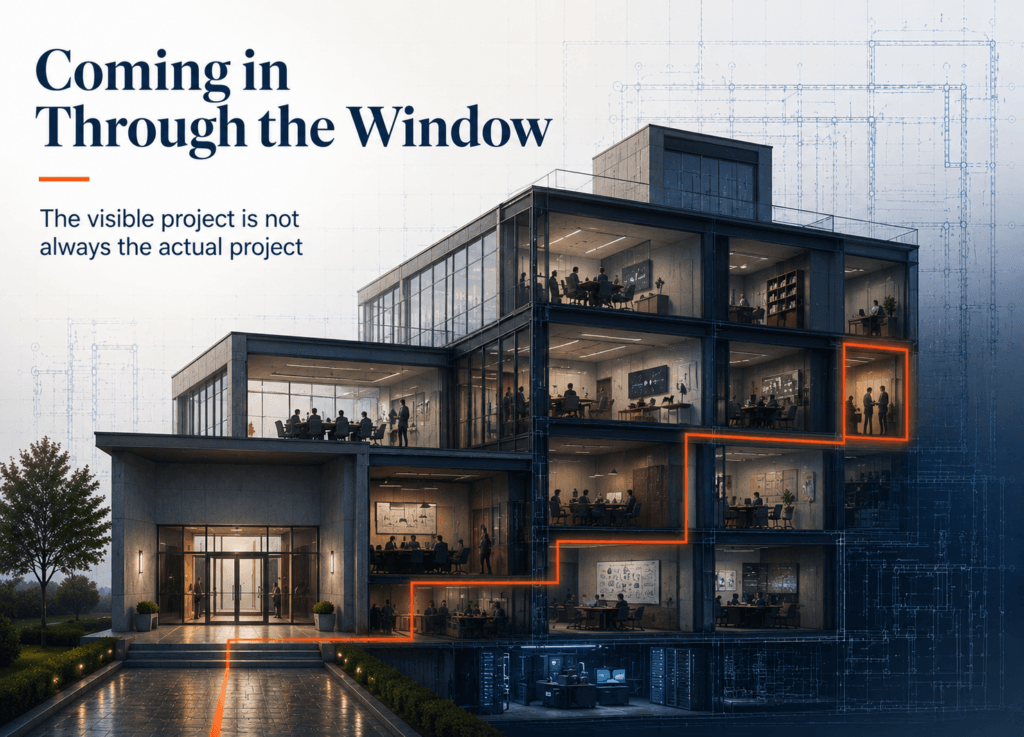
Clients usually call about the project they can see: a platform migration, a MarTech audit, a rebrand, a new website, a process that needs to be documented, a campaign that needs to get out the door.
Those are real projects. They need to get done.
But they are not always the actual project.
Sometimes the visible project is simply the easiest place to start.
The project someone asks for and the outcome they need are not always the same thing
Take a technology migration. At its most basic, the work is straightforward: move the assets, rebuild the integrations, test everything, and turn on the new platform.
You can do exactly that and still miss the point.
If the old platform contained bad segmentation, unnecessarily complicated processes, outdated templates, poor governance, or workarounds nobody should have built in the first place, a clean migration simply gives all of those problems a new home.
The better question is:
What should this migration make possible that is difficult or impossible today?
Maybe it is better testing. Better personalization. Cleaner segmentation. A simpler campaign process. More useful data for Sales.
Now the project is no longer just about moving from Platform A to Platform B. The migration is the opening to fix something bigger.
That is what I mean by coming in through the window.
Sometimes the front door creates too much resistance
This becomes even more important during major change. Mergers, acquisitions, divestitures, rebrands, leadership changes, and major technology shifts already put people on edge. Roles may be changing. Teams are being reorganized. People are wondering what happens to their jobs, budgets, systems, and priorities.
Walking through the front door and announcing another major initiative can be the fastest way to make everyone dig in.
“We need to redesign the lifecycle.”
“We need to change how these teams work together.”
“We need a new operating model.”
Even when all of those things are true, the organization may not be ready to hear them. So you find the window.
On one project, we knew the organization needed much stronger lifecycle alignment, but there was no appetite for a full lifecycle redesign. Instead, we introduced the lifecycle map as shared language.
We did not ask teams to change their programs. We did not tell them they were doing anything wrong. We simply asked that when work came through for execution, they identify where it fit in the lifecycle.
That sounds minor.
It was not.
Once people knew they would eventually have to answer, “Where does this fit?” they started asking themselves that question earlier. The framework began influencing how they thought about the work before we ever asked them to change the work.
By the time the larger lifecycle conversation became appropriate, they were already partway there.
The visible project can also give people something safe to rally around
On another large transition, everyone referred to the work as the “MarTech audit.”
That was not really the whole project. Technology was certainly part of it, but the work also touched ownership, processes, documentation, governance, roles, decision-making, and how different teams would operate together.
“MarTech audit” was simply the thing everyone understood.
And that was useful.
There was no reason to force the organization to absorb the full complexity of the work on day one. The familiar project created an opening to ask bigger questions and uncover what actually needed to change. The transition itself created an opportunity to address problems that had been much easier to tolerate during business as usual.
The visible project got us through the door.
The actual work helped the organization function better.
You do not always need alignment to create movement
This is another place where teams get stuck. They know several functions need to work together, so they start by trying to get everyone aligned.
Sometimes that is necessary.
Sometimes it is exactly the wrong first move.
If Marketing, Sales, regional teams, Operations, and other functions are already headbutting, asking everyone to agree on a new cross-functional approach can turn into weeks of meetings with very little movement.
There is another option: start by gathering information.
What is Sales focused on right now? What is the regional team prioritizing? Where is Marketing already investing? What is working? Where are things getting stuck?
You are not asking anyone to change direction yet. You are understanding the directions that already exist.
Then look for the place where you can make those efforts work better together. Maybe Marketing can support the accounts Sales is already prioritizing. Maybe nurture can help revive opportunities that have gone cold. Maybe Operations can create a common definition that reduces confusion between two teams.
You are creating coordination before asking for collaboration.
That distinction matters.
The path of least resistance is not the path of least impact
There is a tendency to treat the path of least resistance as the easy way out.
That is not what I mean.
Sometimes the lowest-resistance move is the smartest way to get to the harder change. The goal is still the larger outcome. You are simply paying attention to what the organization can absorb and what will create enough movement to make the next decision easier.
A few questions help:
- What is the visible project everyone already agrees needs to happen?
- What business outcome is that project supposed to support?
- What underlying issue will limit that outcome if nobody addresses it?
- What can we introduce now without requiring the organization to swallow the entire change at once?
- What small decision, framework, process, or shared language would make the next change easier?
That is not avoiding the hard work. It is sequencing the hard work so it has a better chance of sticking.
Delivering the visible project perfectly can still be a failure
You can migrate every asset correctly. You can launch the new website on time. You can complete the audit. You can update every template with the new brand. You can check every box in the project plan.
And six months later, the same broken processes, competing definitions, unclear ownership, disconnected teams, and bad decisions can still be there.
That is why I keep coming back to the distinction between the visible project and the actual project.
Do the work that has to get done.
But keep asking what the work is supposed to change.
Sometimes the front door is open and the organization is ready for the bigger conversation.
And sometimes you have to come in through the window.
About the Author

Brandi Starr is an impact-focused marketing executive and Chief Experience Officer at Tegrita, a consultancy that helps $100M+ B2B companies build revenue engines that scale. With over 25 years of experience, Brandi transforms marketing operations from tactical execution into strategic revenue drivers by aligning people, platforms, and processes. Named one of the Top 50 Women in Martech, she is co-author of CMO to CRO: The Revenue Takeover by the Next Generation Executive and host of the Revenue Rehab podcast. Brandi's process-first approach optimizes existing investments to deliver measurable, scalable growth for enterprise organizations.