
» Your Transaction Announcement Is Not a Communication Strategy




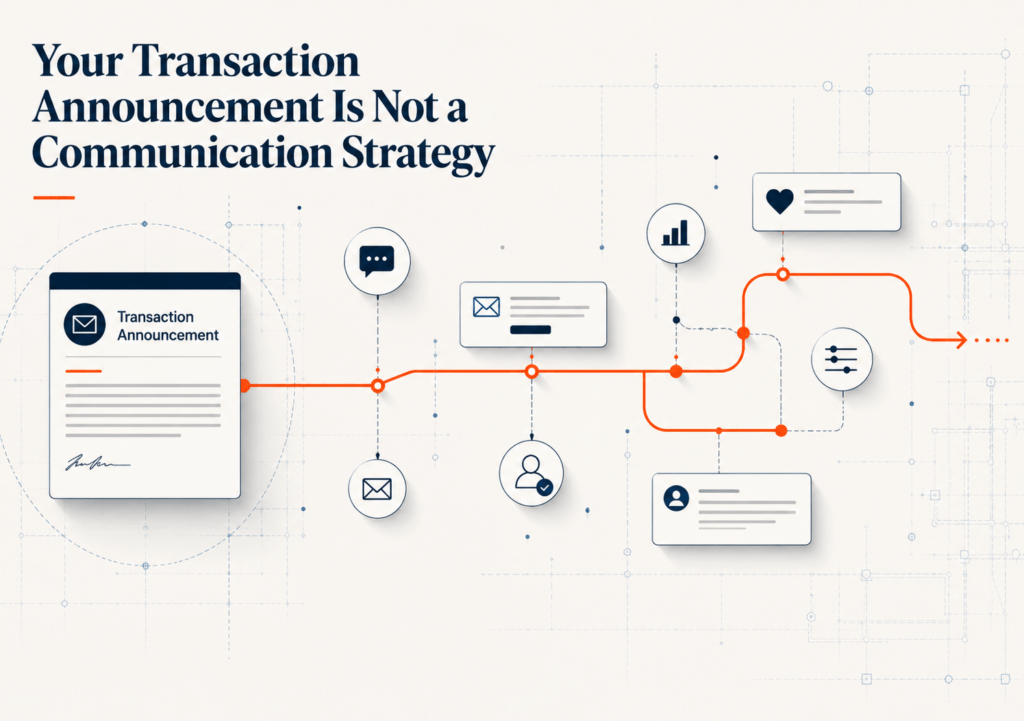
The required communications may get you through the transaction. What you say next helps shape the customer relationship that comes after it.
I’ve been through mergers, acquisitions, and divestitures from both sides of the table, as part of the company going through the change and as a consultant helping clients navigate it. And I keep seeing the same thing happen.
There is a ton of attention on the customer communications that have to happen. The company name changed. Billing information is different. Contracts are moving to a new legal entity. Support contacts changed. Customers need to know what is happening, when it happens, and whether they need to do anything.
All important. But somewhere between Legal, Finance, Operations, Marketing, and everyone else trying to get to launch day, those required communications quietly become the customer communication strategy.
And they aren’t.
The transaction gives you a reason to talk to your customers. Use it.
Your customers are already wondering what the change means for them. Will their service change? Are the same people still there? Is this good news or bad news? What does the new company actually do? Should they expect something different?
A legal notice or billing update may answer what they have to know, but it probably does not answer what they want to know. And this is the part I think companies underestimate: a transaction gives you a completely legitimate reason to get back in front of customers and reintroduce the relationship.
Do not waste that moment telling them only where to send the check.
I tend to think about transaction communications in two buckets:
First Comms: The communications required to get customers through the transition with as little confusion as possible.
Next Comms: The communications that begin building the relationship from there.
First Comms usually get plenty of attention because they have deadlines, legal requirements, and operational dependencies attached to them. Next Comms are much easier to miss.
But if all you tell customers is that your name changed and where to send the check, you have handled the transaction. You have not necessarily handled the customer relationship.
Beyond the Transaction Announcement
What your customer communication plan needs to answer

What I tell my clients to do with this
I would not circulate this as another checklist and hope everyone reads it. This is a conversation tool. Pull the right people together, walk through it, and use it to expose what has actually been decided, what is still moving, and what nobody has thought about yet.
1. Get beyond Marketing
One of the first things I tell clients is that customer communication during a transition is not just a Marketing project. Depending on the change, you may need input from Sales, Customer Success, Support, Legal, Finance or Billing, Operations, Data, and Technology.
You do not need everyone in every meeting. That usually creates its own problems. But you do need to know whose decisions, information, or execution the communication depends on.
2. Separate “we’re working on it” from “it’s decided”
For each question in the framework, I like three simple buckets:
- Decided
- In motion
- Unresolved
Because “someone is working on it” and “we have made the decision” are very different things.
The unresolved items I pay the most attention to are the ones something else is waiting on. A communication cannot be finalized because Legal has not decided X. Segmentation cannot happen because the customer data is not ready. Sales cannot answer questions because nobody has agreed on Y. Those dependencies are where things tend to get messy fast.
3. Look at the transition through different customer eyes
Not every customer is experiencing the same change. A long-time customer being moved to a new legal entity may have very different questions than someone who recently bought, someone with an open support issue, or someone who knows one of the legacy brands but has never heard of the new company.
So before deciding what to send, I always come back to one question:
Who is this audience, what actually changed for them, and what are they likely to be wondering right now?
That usually leads to a much better communication plan than starting with, “What email do we need to send?”
4. Plan the Next Comms before the First Comms are finished
You do not need every future campaign mapped before the transaction announcement goes out, but you should know what happens next. What is the next thing you want this audience to understand? What concerns might need to be addressed? What relationship are you trying to build? What action or experience should follow?
Do not let the transaction announcement become the end of the conversation by default.
I have seen this happen simply because everyone was so focused on getting through launch that nobody owned what came after it.
5. Make sure the operation can support the communication
This is the other place my brain always goes. The messaging may be great, but can the organization actually deliver it?
Do you have the right audience data? Can you segment appropriately? Are consent and preferences being handled correctly? Does everyone know who owns the follow-up? Can your systems support the experience you just designed? What are you going to measure?
That is why I do not think about customer communication during a transition as just a messaging exercise. There are people, process, technology, and data decisions underneath almost every communication you send.
The announcement is one moment.
The bigger question is what you want the customer relationship to look like after it.
About the Author

Brandi Starr is an impact-focused marketing executive and Chief Experience Officer at Tegrita, a consultancy that helps $100M+ B2B companies build revenue engines that scale. With over 25 years of experience, Brandi transforms marketing operations from tactical execution into strategic revenue drivers by aligning people, platforms, and processes. Named one of the Top 50 Women in Martech, she is co-author of CMO to CRO: The Revenue Takeover by the Next Generation Executive and host of the Revenue Rehab podcast. Brandi's process-first approach optimizes existing investments to deliver measurable, scalable growth for enterprise organizations.